July 4th, 2026
Paris
I. On Filters
Before I arrived, I thought I knew Paris. I’d read enough, scrolled enough- the romantic reverence of Taiwanese writers, the chic aesthetics of Korean and Japanese influencers, the particular longing in accounts by Hong Kongers and Chinese. When I finally got there, I felt almost all of it was projection. Not observation. Projection.
The mechanism isn’t hard to understand. Societies across Asia are built on collectivity, efficiency, the suppression of the individual. Paris, for many people, represents the opposite-a life lived on aesthetic terms, answerable to no one. When they look at Paris, they’re really looking at a version of themselves they didn’t get to become.
But I held a quiet question about my own seeing too. You always bring your own eyes-your history, your taste, every frame of reference you’ve accumulated without knowing it. I’ve long been aware of this in myself- the vividness of imagination as its own distortion, the risk of filling a real place into the shape of an imagined one. I try to watch for it.
And yet there is something that only arrival can do. Things become concrete. The imagination gets corrected. Sometimes you arrive and realize you didn’t actually want it -the desire was in the distance, and up close it quietly dissolves. Sometimes the opposite: you arrive and know, for the first time, that you truly do. Either way, you just know. That kind of clarity is hard to get any other way.
The Paris I found was simpler than the one I’d been handed. History in the stone, good buildings, people who weren’t in a hurry. Along the Seine there was a stretch of path where I slowed down without deciding to. Tall trees, light coming through in pieces, the particular quiet of a place that isn’t trying to be anything. Then a wave of heat, and suddenly I was thinking of home – another city on a river, the same green, the same summer weight in the air, the same ease in the way people moved. I hadn’t expected to find an echo here. But that’s what it was.
II. On the French
Moving between museums and streets-and thinking back to French classmates I’d known- I began to form an impression of this people, though I hold it lightly.They seem to feel things intensely, pursuing detail, complexity, beauty with a kind of seriousness that reads almost like pride. Their anger, when it shows, arrives with the same force. There’s a directness to it that I found, unexpectedly, refreshing. Yet the surface stays quiet. Contained.
A French friend, educated in the US, told me that communication between generations in French families is often close to absent- nothing like the openness he’d encountered in America. I found a French word for it: pudeur. Something like emotional reticence, a deep-rooted habit of not showing what you feel-not coldness, but privacy. Feelings belong to you. They are not for public display, not even within the family.
The outlet exists, though. Wine, food, the arrangement of a room, art- these are the permitted channels. Indirect, wrapped in form, asking nothing of you explicitly, and yet somehow everything arrives. It’s a very refined emotional language. And their beauty has a stillness to it that doesn’t need anyone else’s gaze to hold it in place.
III. On Gauguin
A panel of text beside a Gauguin exhibition at the Musée d’Orsay stopped me for a long time. He described the women of Tahiti as works of God and nature- a purer existence, far from the artificiality of Paris. I understand the impulse: the disillusionment with civilization, the longing for something more essential, the courage it takes to walk away from the life you were supposed to live and toward something you couldn’t yet name. That longing produced genuinely revolutionary work- pure colour, flattened form, the dismantling of Western perspective.
But I don’t look away from the other facts. He lived with several young local girls in Tahiti, the youngest barely a teenager. He framed these relationships in his writing as natural unions. They weren’t. They rested on colonial power- women who had almost no ability to refuse a European man. He left them. On his canvases, he turned them into symbols, into landscape, rather than people with their own will and pain. Whether this was blindness or chosen blindness, I’m not sure it matters. The effect was the same.
What stays with me is that his artistic power and his treatment of those women may have come from the same root. Greatness and moral failure aren’t always separate. Sometimes they grow from the same place. That’s not a reason to dismiss the work. It’s a reason to keep a clear head when genius pulls you toward worship.
IV. On Art and What Lasts
I always believe there is something about great art that doesn’t need to be explained to you- it is simply good, and you know it immediately. Not because you recognize the name, not because it hangs in an important museum. It’s in the brushwork, in whatever is transmitted through the surface, in the fact that it has survived this long without disappearing. Real appreciation isn’t finding confirmation of your own taste in a work. It isn’t seeing yourself. It’s seeing something that has always been certain- something larger than you.
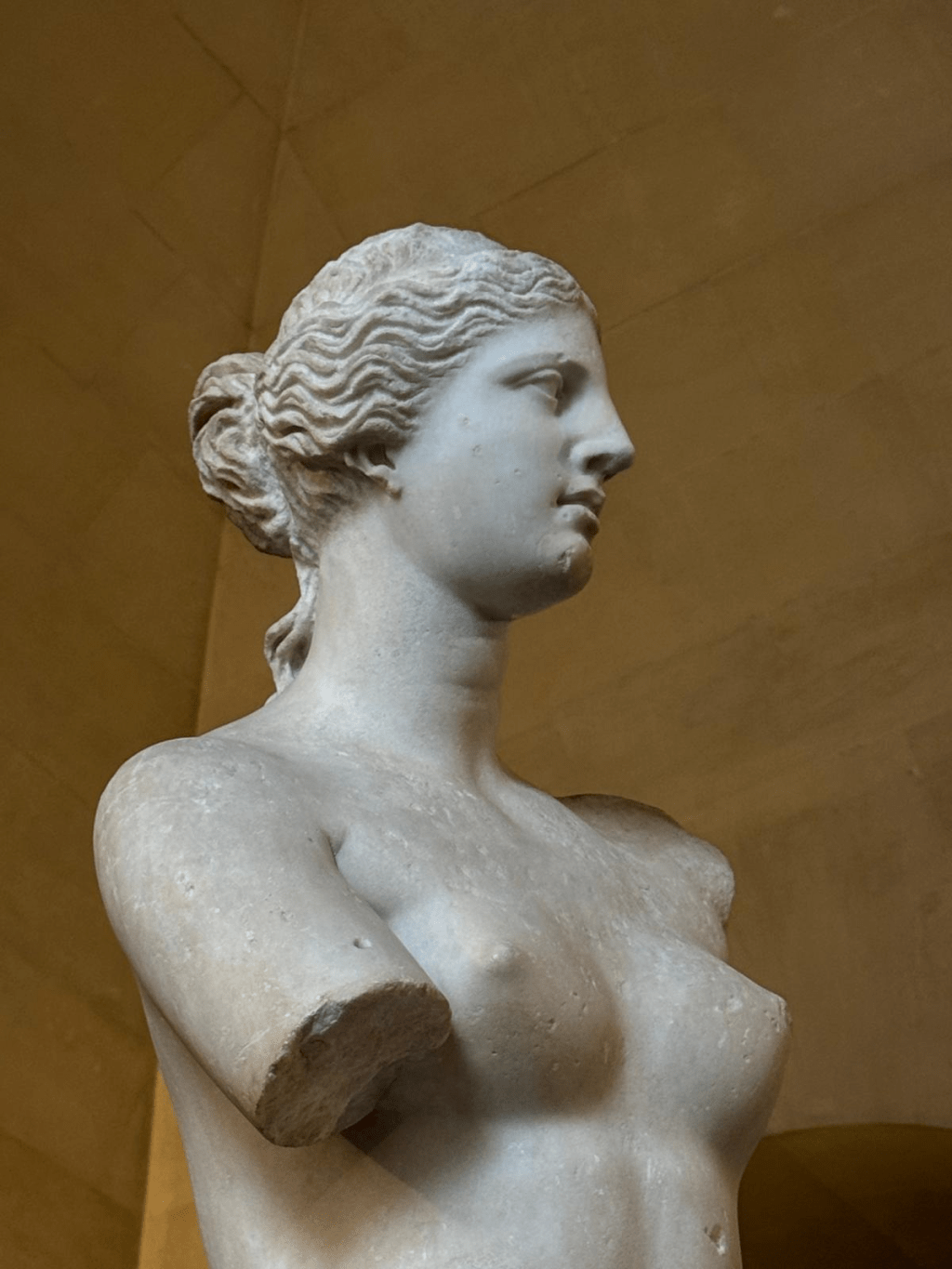
The Venus de Milo stopped me for a long time. Beautiful from every angle, no angle wrong. There is something in ancient Greek sculpture that I have always been drawn to-a divine beauty with no lust in it, no possession, no wanting.
Human desire is an infinite game- endlessly played, never finished. Films and art have mapped its every detail, some explored the darkest corners of human nature again and again. But when you walk away from those things, they feel so light. They will be washed away by time. Standing in front of the Venus, I thought of something else: that people can choose to become more than servants of their own appetite. That is the harder thing. It is also the more lasting one.
Barcelona
V. On Gaudí
Barcelona, for me, was almost entirely one man.
Gaudí said something that stopped me in Sagrada Família: To do things right, first love, then technique. Something I’d been slowly finding my own way toward. Hearing it said so plainly felt like recognition.
His madness had a premise people often miss: he was structurally rigorous to an extreme. Hanging chain models to calculate arch loads. The geometry of bones, trees, honeycombs. He believed natural form was God’s most perfect architectural language. The Sagrada Família’s columns rise like a forest; the facades suggest lava and bone. Not decoration-theology, and engineering. Real greatness often works this way. What looks like madness from outside is, from inside, the strictest possible logic.
In the Gothic Quarter, I walked into a small, worn church where Gaudí had prayed every day in the last years of his life. Bullet holes still in the walls. Unrepaired. Just left there. As a young man he dressed well, moved easily among the wealthy-that fluency was how he landed the commissions that made him. He gave all of it up. Near-ascetic in the end, everything going to the Sagrada Família. My client is not in a hurry. I think he had genuinely stopped caring about the rest. When you find the thing that actually drives you, comfort and respectability don’t disappear-they just stop mattering. That’s different from sacrifice. It’s a reordering.
VI. On Picasso
The Picasso Museum holds mostly his early work- enough to trace the full arc from classical mastery to cubist radicalism. He didn’t abandon realism because he couldn’t do it. Realism had simply become too shallow. His sensitivity to human psychology was extraordinary; his ability to catch the exact emotional register of a figure, almost uncanny.
But I looked at the other side too. Across his major relationships, the pattern barely varied- obsession, possession, exhaustion, next. He said it himself: women were either goddesses or doormats. The women close to him include one who broke down, one who took her own life years after his death, and the only one who left him of her own accord-who then faced years of retaliation.
Honestly, I feel this way of seeing women isn’t rare even today. What made Picasso unusual wasn’t the attitude. It was the power to live it out without consequence, and the arrogance to say it aloud.
Virtue runs narrow. The wide roads need no effort-they follow instinct, ask nothing, and are always full. Some artists are explorers of those wide roads, walking human darkness to its edges and leaving the map behind. That matters. But their expeditions are sometimes paid for with their own or even other people’s lives. Gauguin’s cost was borne by those girls. Picasso’s cost was borne by those women. This isn’t condemnation. It’s what humans are. We all carry this darkness; the difference is whether we have the will to hold it in check.
The question worth asking- especially when people are young, before the wide roads have taken you somewhere hard to come back from-is not what you can get away with. It’s what a good life actually looks like.
Coda
VII. Woody Allen and the Present
Coming home, I thought of two Woody Allen films I’d loved when I was younger-Midnight in Paris and Vicky Cristina Barcelona. Two cities, same subject: people using fantasy to avoid what they actually need to face.
There’s a wildness in the Catalonian art, and in the people-something a bit dangerous, magnetic. But the best of it is anything but careless. Gaudí spent decades on a single building. Picasso said it himself: it takes a long time to become simple.
This trip wasn’t in the plan. A friend kept telling me it was worth it, and he was right. In Barcelona, a stranger in a square handed me pigeon feed, and for a moment the whole flock took flight at once, landing on my arms, my shoulders, everywhere. The joy of that moment stayed with me. Good food, unexpected encounters, kindness and warmth along the way, a lot of inspirations- even some thoughts on investing. One small thing went wrong, and somehow made everything more amusing.
I felt blessed all the way through.

Leave a Reply